
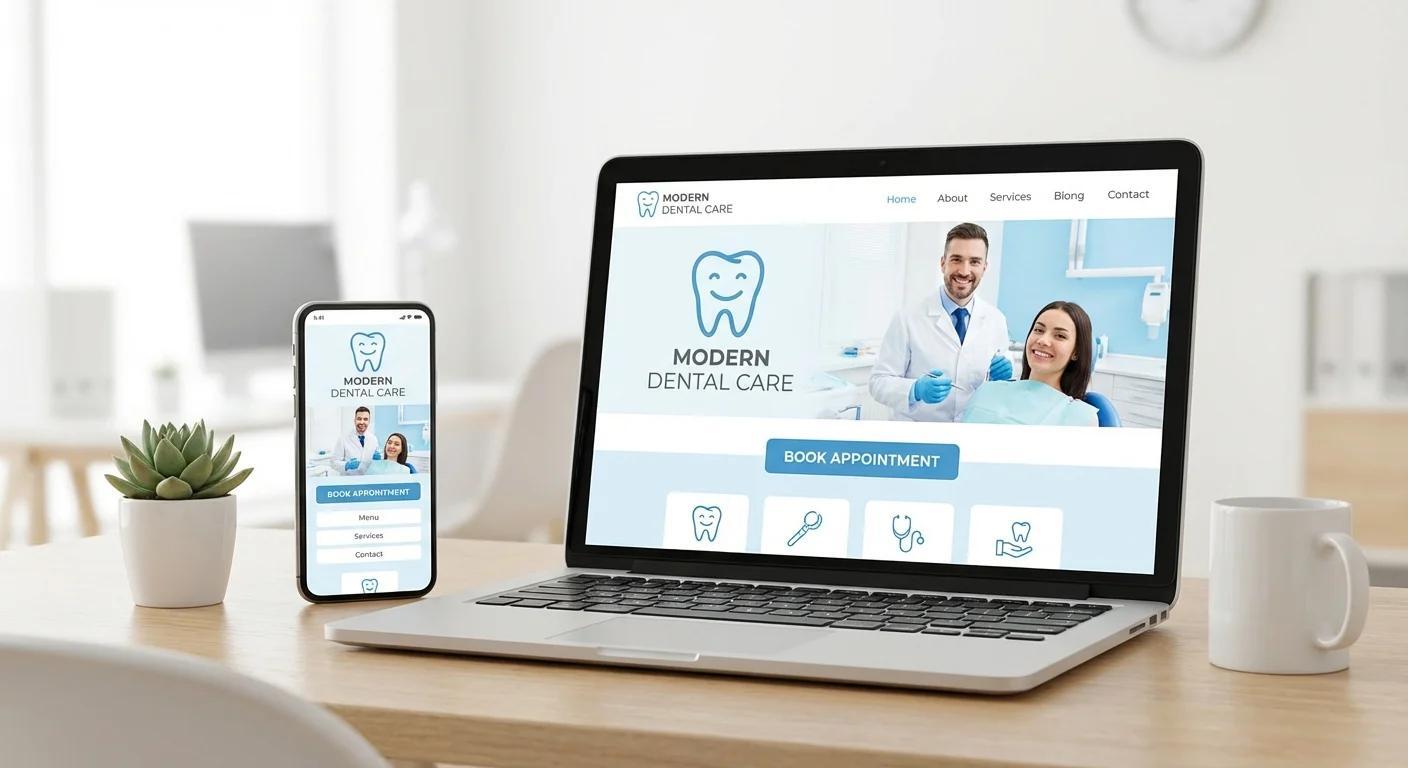
Your dental website is losing patients right now. Not sometimes. Every single day.
Most dentists spend money on Google Ads and referrals and then send every potential patient to a website that drives them away. These 7 mistakes are the real reason your phone isn’t ringing enough. Fix even three of them, and you’ll see more new patient inquiries within 60 days.
I’m breaking down the truth about dental website optimisation, the math behind dental website design and conversion, and why the “keep it simple” advice from most web designers is actually a trap.
Key Points
- Thin service pages, poor mobile experience, no structured data, and a weak conversion strategy are the top issues costing practices new patients.
- Mobile-optimised dental websites see up to 60% more bookings than sites that aren’t optimised for phones.
- AHPRA registration, Australian Dental Association membership, real clinic photos, patient reviews, and medically reviewed content all build trust with patients and Google.
- Moving from a 3% to 10% conversion rate on 1,000 monthly visitors can add $140,000–$280,000 in yearly revenue without extra ad spend.
Is Your Dental Website Working Or Just Sitting There?
There’s a big difference between having a dental site and having one that gets results. I’ve looked at dozens of Australian dental practices online. The same problem keeps showing up. A skilled dentist with a website that looks like it hasn’t been touched in years.
Here’s exactly where it’s going wrong.
Mistake #1: Your Site Doesn’t Work on Mobile
Most people search for a dentist on their phone. Google also ranks websites based on how they perform on mobile. If your dental web page design looks fine on a desktop but breaks on a phone, it won’t rank and it won’t convert visitors into patients.
Recent data shows that mobile-optimised dental websites see up to 60% more bookings than sites that aren’t mobile-friendly.
Four things a mobile-ready dental website needs
- Big, easy-to-tap buttons and phone numbers
- A simple booking form, not a 10-field form no one fills in
- Fast load speed that passes Google’s Core Web Vitals
- A click-to-call button visible on every page
I’ve seen practices spend thousands on dental web page design and never test it on a phone. The whole thing failed because it took 9 seconds to load on mobile. Don’t make that mistake.
Mistake #2: You’re Ignoring Your Google Business Profile
The local map pack shows up above regular search results and it gets over 40% of all clicks. Yet most dental practices treat their Google Business Profile as an afterthought.
78% of local mobile searches lead to a visit within 24 hours. That’s a stat you can’t ignore.
Your Google Business Profile checklist
- List every service clearly not just “General Dentistry”
- Upload real clinic photos updated in the last 6 months
- Make sure your name, address, and phone number match your dental site exactly
- Ask every patient to leave a review after their visit
- Update your posts and Q&A section monthly
Map pack visibility can improve in 8–12 weeks with consistent updates. This is free dental website marketing; use it.
Mistake #3: Your About Page Does Nothing for Trust
Here’s something most dental website designers won’t say: your About page is one of the most important pages on your whole site. Patients aren’t just picking a clinic. They’re deciding who gets to work inside their mouth. That’s personal.
What a strong dentist bio page includes
- Specific clinical experience. Don’t say “15 years of experience.” Say “15 years helping anxious patients who’ve been avoiding the dentist.” That speaks directly to someone.
- Real photos. Ditch the stock images. Use real clinic photos and real photos of your team. This builds trust before a patient even calls.
- Qualifications and memberships. Show your AHPRA registration. List your Australian Dental Association membership. These are trust signals. They tell patients you’re legitimate and accountable.
- A credentials statement on clinical pages. Google puts dental content under stricter E-E-A-T rules because it’s health-related. Adding a “medically reviewed” note and listing professional dentist qualifications directly on treatment pages helps you rank and builds patient confidence.
Mistake #4: Your Service Pages Are Too Thin
I’ve seen this fail over and over. A practice offers implants, Invisalign, emergency care, and sleep apnoea treatment. All on one “Services” page with three sentences each. That’s not dental service page optimisaa wastedtion. That’s wasted opportunity.
Every treatment needs its own page. Each page should include
- A clear keyword in the heading like “Dental Implants in [Your Suburb]”
- A simple treatment explanation a nervous patient can actually understand
- A short FAQ answering what patients actually search for
- A direct call to action to book
One practice built out individual service pages with full treatment explanations. Bookings for that specific treatment went from 8 per month to 34, adding over $150,000 in yearly revenue. That’s what proper dental website SEO looks like.
Mistake #5: You Have No Real Conversion Strategy
Most dental practices convert between 2–4% of website visitors into booked patients. Practices with a proper system convert 8–12%. On 1,000 monthly visitors, that gap means up to 80 extra appointments per month.
But most dental websites just have a phone number at the top of the page. That’s it.
Your dental website marketing needs more than one way to convert a visitor:
- Online booking available 24/7 with a short, simple form
- Live chat or a chatbot for after-hours questions
- Trust badges near your booking button; your Google rating, ADA membership, years in practice
- People often decide to book late at night. If you’re not available then, someone else gets that patient.
Mistake #6: Your Content Has No Structure or Depth
Thin content with no strategy is one of the biggest SEO problems for dental websites I see. Random blog posts don’t build authority. Disconnected pages don’t rank.
Google wants to see that your site knows its topic inside out. This is called topical authority.
Here’s how to build it:
Your dental implants page should link to a bone grafting page. That page links to an aftercare page. That page links back to an implants FAQ. This is called a content cluster and by internally linking these pages, you signal expertise to Google.
Every key treatment page should be reachable within two clicks from your homepage. That’s it. That’s your dental content marketing strategy in simple terms.
Mistake #7: You Haven’t Set Up Schema Markup
Most dentists have never heard of this. But it’s one of the lowest-cost, highest-return improvements you can make to a dental site.
Schema markup, specifically Dentist schema and dentist profile schema tells Google exactly who you are, what you treat, and where you’re located. It makes your listing eligible for star ratings and service details right in the search results.
And yet the majority of Australian dental websites have zero schema installed. It costs very little in dental website design cost terms to add. The SEO return is significant.
DIY vs. Professional Dental Website Optimisation
| Element | DIY | Professional Dental SEO |
| Mobile Optimisation | Theme toggle in CMS | Full speed audit and rebuild |
| Service Pages | One generic page | Individual pages per treatment |
| Google Business Profile | Basic details added | Full strategy with ongoing updates |
| Schema Markup | Usually skipped | Dentist + LocalBusiness schema added |
| Conversion Strategy | Phone number only | Booking form, live chat, trust badges |
| Dental Website Design Cost | $500–$2,000 (template) | $4,000–$15,000 (custom, SEO-ready) |
People Also Ask
1: How much does dental website design cost in Australia?
Custom, SEO-ready sites run $4,000–$15,000. Cheaper templates usually cost more to fix later.
2: Does my dental site need a blog?
Only if it’s strategic. Random posts don’t help. Content clusters built around real patient questions do.
3: How long does dental website SEO take?
Expect 3–6 months for competitive keywords. Local map pack results can improve within 8–12 weeks.
4: What is E-E-A-T and why does it matter for dentists?
It stands for Experience, Expertise, Authoritativeness, and Trustworthiness. Google applies stricter standards to health content. Showing qualifications, credentials, and clinical experience directly on your site helps.
5: Can I fix my dental website myself?
Some things, yes. Updating your GBP, adding service pages, and requesting reviews. But schema, technical SEO, and content strategy are easy to get wrong. Know where to draw the line.
Final Words
Don’t try to fix everything at once. You’ll do nothing.
Open your dental website on your phone right now. Try to book an appointment in under 30 seconds. If you can’t or if the page is slow or confusing, you’ve found your biggest problem.
Fix mobile first. Everything else follows from there.