SEO vs Google Ads for Dentists in Australia: Which Gets More Patients?

Dental marketing strategy combining SEO and Google Ads for Australian clinic patient growth

Most Australian dentists lose patients online every day. Not because their clinic is bad. Because they picked the wrong marketing channel, and now AI search tools are changing things again before most clinics even caught up with Google. If you need patients this month, Google Ads wins. If you want to own your suburb on Google for years to come, SEO wins. But the dentists actually growing right now aren’t picking one. They’re running SEO and Google Ads together, while also making sure they show up when patients ask ChatGPT or Google’s AI Overviews for a recommendation.  We built The Xyro’s SEO and PPC services because we kept seeing dentists waste money on one channel while ignoring the other and now ignoring AI search too. I’ll walk you through the real numbers behind dental SEO, what PPC for dentists actually costs, and why “just pick one” is bad advice. Key Takeaways Google Ads gets your dental clinic to the top of search results within a day, making it the fastest way to bring in new patients. Local SEO for dentists improves Google Maps rankings through a complete profile, local citations, and steady patient reviews. Dental SEO usually returns 5:1 to 20:1 once it gains momentum after 6 to 12 months. AI Overviews and tools like ChatGPT now answer dental questions directly, so clinics need consistent details online, not just good rankings. Does Google Ads Actually Work for Dentists? A dental patient is worth $10,000 to $15,000 over their lifetime. The average cost per lead through Google Ads sits around $86. Even if only half those leads turn into bookings, you’re paying about $172 for a patient worth thousands more. That’s a strong return. But most clinics still get poor results from paid search vs SEO comparisons. Not because Google Ads is broken. Because of what happens after someone clicks. I’ve watched dental practices spend $4,000 a month on Google Ads for cosmetic dentists and get three leads back. The ads were fine. The landing page killed everything. A dedicated landing page converts at 12.5%. A normal homepage converts at 4.2%. Fix the page first. Then spend on ads. AI Is Already Steering Your Ad Budget Google’s Smart Bidding tool uses AI to set your bids automatically based on things like device, time, and location. It makes thousands of tiny decisions every second. That sounds great, but it has a catch. Hand it full control without clean conversion data, and it can waste your budget fast. I’ve seen clinics turn on automatic bidding, walk away, and watch their cost per lead double. AI bidding only works well when the data behind it is accurate. At The Xyro, we fix your landing pages and tracking first. Sending traffic to a broken page, even with smart AI bidding, is like filling a bathtub with the plug pulled out. Is SEO Worth It for Dentists in Australia? Dental SEO takes about 4 to 6 months to show real movement. Google Ads gets you to the top within a day. That’s the trade off. But once SEO kicks in, the return is strong, often between 5:1 and 20:1. You’re not paying per click anymore. Traffic keeps coming even on days you spend nothing. Local SEO for Dentists Hides the Real Money A fully filled out Google Business Profile brings in up to 7 times more phone calls. That can mean an extra $75,000 a year per clinic location. All from a free listing, set up properly. Reviews matter just as much. Most people check dental clinic reviews before booking. A clinic with 80 reviews at 4.7 stars will always beat one with 8 reviews at 4.2 stars, in rankings and in trust. The AI Search Shift Here’s the part that should worry you more than your ranking position. Google’s AI Overviews now show up above regular search results and above ads for many dental searches. Someone can search “best Invisalign dentist near me” and get an answer without clicking a single link. It doesn’t stop there. Patients now ask ChatGPT which dentist nearby takes their insurance and works well with kids. If your clinic isn’t listed consistently across the web, you don’t show up in that answer at all. One recent check found most dental practices are completely invisible to AI search tools right now. That’s most of the industry missing out. The fix overlaps with good local SEO. Same business details everywhere, a complete Google profile, and detailed reviews mentioning real services. But it’s not exactly the same thing, and treating them as identical is how clinics fall behind. Stop Asking the Wrong Question Everyone asks: SEO or PPC for dentists? Wrong question. The real question is where your practice stands right now, and whether patients can even find you across Google, paid search, and AI tools. New clinic with no patients yet? Run Google Ads now for quick cash flow while SEO and AI visibility build underneath it. Established clinic pouring money into dental PPC advertising with no SEO plan? You’re renting your visibility. Stop paying and you vanish, from Google and from every AI answer that might have pointed a patient your way. SEO vs Google Ads: Side by Side Factor SEO for Dentists Google Ads for Dentists Time to Results 4 to 12 months 24 to 48 hours Cost Structure Monthly retainer Pay per click Long Term Return 5:1 to 20:1 2:1 to 4:1 AI Involvement Feeds AI Overviews and ChatGPT answers Smart Bidding automates targeting Traffic Stops If You stop creating content You pause your budget Best For Long term trust and growth Fast leads, new clinics Frequently Asked Questions 1. Why is my dental website not getting enough traffic from Google?  It usually comes down to weak local SEO, thin content, and a Google Business Profile that isn’t filled out properly. Start there. 2. Why is my dental clinic not ranking high on Google?  Your competitors are simply putting in more consistent work. Rankings depend on reviews, backlinks,

Google Business Profile for Plumbers: How to Generate More Local Leads

Plumber adding job photos to Google Business Profile for local lead generation

Your Google Business Profile is probably incomplete, outdated, or losing to competitors on reviews. Complete profiles get seven times more clicks than incomplete ones, and that gap keeps growing as Google leans harder on AI to answer local searches. Fix the profile first. Everything else comes after. We built Xyro’s Google Business Profile service because we kept seeing the same problem. Good plumbers, terrible online visibility. Their trucks were busy but their listings sat there half finished, missing photos, missing categories, missing everything that actually gets a homeowner to click “Call.” I’m going to walk you through why you’re invisible on Google, what the math on reviews actually looks like, and why “just get more reviews” is advice that can backfire if you rush it. Key Takeaways Complete Google Business Profiles get seven times more clicks than incomplete ones. Crossing 50 reviews at 4.5 stars or higher is the point where you start beating weaker competitors consistently. Steady review velocity of 10 to 15 monthly beats a huge one time spike. AI search tools now rely on the same GBP data that traditional Google ranking uses, so fixing your profile helps both. Why Isn’t My Plumbing Business Showing Up on Google? Google Business Profile optimization starts with one brutal truth. Complete Google Business Profile listings receive 7 times more clicks than incomplete profiles, according to Google Business Profile Insights data cited in 2026 industry reports. Not seven percent more. Seven times. That’s the difference between 5 calls a week and 35. The Category Mistake I’ve seen plumbing businesses’ SEO fail simply because they picked “Plumber” as their only category and stopped there. No “drain cleaning.” No “water heater installation.” No “emergency plumber.” Google matches searches to categories before it even looks at your website copy. Miss the category, miss the customer. The Photo and Description Gap Profiles with descriptions over 750 characters get 2.5 times more impressions than the bare minimum. And home services businesses tend to run photo heavy compared to other industries, with an average of 70 photos. If your listing has three photos from three years ago, you’re not competing. You’re barely present. Here’s a quick real world example. One client we worked with at Xyro had a profile stuck since 2021. Same three photos. One category. We rebuilt the categories, added weekly job photos, and fixed the service area radius. Calls picked up inside a month. Nothing fancy, just filling in what was missing. That’s what real Google Business Profile management looks like in practice. Why Are Other Plumbers Ranking Above My Business on Google? Reviews. It’s almost always reviews. Once you cross 50 reviews at 4.5 stars or higher, you start consistently winning local pack clicks against weaker competitors. And businesses with 50 or more Google reviews earn roughly 266% more leads than those with fewer than 10. That’s not a small edge. That’s the whole game when it comes to plumbing lead generation. Checklist: what actually moves ranking for plumbers local SEO Ask for a review within 24 to 48 hours of finishing the job, while the relief is still fresh Respond to every single review, good or bad, within two days Keep the pace steady instead of chasing big spikes Watch your monthly review count, not just your lifetime total Never buy reviews. Google’s detection has gotten aggressive in 2025 to 2026, and fake reviews get removed while repeat offenders get suspended. Here’s the part most agencies won’t tell you.  Piling up fifty reviews in one weekend can hurt you. Volume matters less than velocity. A plumber pulling 10 to 15 fresh reviews every month can outrank one who collected 200 reviews two years ago and stopped. Steady beats sudden, every time. How Can I Get More Plumbing Customers Through Google Business Profile? It comes down to three moves, in this order of importance. Fill in every single field. Services, service area, business attributes, holiday hours. Nobody updates holiday hours and it quietly costs real jobs. Post something weekly. Google Posts are underused. They tell Google you’re active, not dormant. Seed your own Q&A section. Add the questions people actually ask, like pricing ranges and how fast you respond to emergencies. Because traffic without conversion is useless. If a hundred people view your profile and only four call, more traffic won’t fix that.  The problem is your photos, your reviews, or your response time. This is why working with a proper plumber SEO company matters. Fix the profile before you spend a dollar chasing more eyeballs. Do Google Reviews Help My Plumbing Business Rank Higher Locally? Yes. Completely.  97% of consumers read online reviews before choosing a local business, and for plumbing specifically, that trust factor matters even more. You’re letting a stranger into someone’s home during a burst pipe or a gas smell scare. Trust isn’t optional. 80% of consumers say they would use a business that responds to all of its reviews. That response habit is cheap to build and expensive to skip. One plumbing owner told us plainly, “I didn’t believe reviews mattered until calls slowed the same week our rating dropped after two rough jobs.” A quarter star swing changes real behavior. It’s not theoretical. Can AI Help Me Get More Local Plumbing Leads From Google? This is the part most plumbing companies haven’t caught up to yet.  AI Overviews and conversational search tools pull from the exact same signals as regular Google search: your review sentiment, your category accuracy, your business hours consistency. If your data is messy in one place, AI treats your entire business as less trustworthy everywhere. Search visibility for plumbers isn’t just about ranking blue links anymore. It’s about being the answer an AI system gives when someone asks, “who’s a good emergency plumber near me.”  That’s exactly the gap Xyro’s approach targets, structuring your profile and citations so both traditional search and AI answer engines can confidently recommend you. DIY vs. Professional GBP Management Factor DIY Management Professional Management Time needed monthly 5

Why Your Google Business Profile Isn’t Bringing Plumbing Leads (And How to Fix It)

Local search optimization for plumbing leads with Google Business Profile.

You’ve set up your Google Business Profile. Added your number. Maybe uploaded a photo or two. And still, the phone’s quiet. Here’s what’s actually going on: claiming your profile is not the same as optimising it. Every day your profile sits half-finished, you’re handing plumbing leads to your competitors. The fix isn’t complicated or expensive. You just need to know what Google looks for, what you’re missing, and what to fix first.  I’m breaking down the truth about GBP signals that move the needle, the math behind local search rankings, and why “just get more reviews” is actually a trap. Key Points Your GBP profile completeness, review signals, and website consistency together make up the majority of your local pack position. Complete your GBP with real photos, correct categories, active posts, and a steady review strategy, then make sure your website backs it all up. Check your secondary categories, service areas, and how recent your reviews are. These are the three most broken things I see in plumbing profiles. Google uses your site to verify what’s on your profile. A slow or mismatched website actively suppresses your local search rankings. Is Your Google Business Profile Really Working For You? Let’s talk numbers. Google Business Profile signals like your categories, photos, business hours, and posts make up 32% of your local map rankings. Review signals add another 20%. So more than half your Google Maps position comes from two things most plumbers barely touch. And 44% of all clicks go to those top 3 map results. If you’re not there, you don’t exist to most customers. The “Set It and Forget It” Mistake I’ve seen this fail over and over. A plumber claims their profile, fills in the basics, and never comes back. Google notices. Competitors who post weekly, add job photos, and keep their info fresh are sending clear signals: we’re active, we’re local, we’re relevant. Your quiet profile sends the opposite message. A properly optimised Google Business Profile for plumbers includes accurate contact details, service areas, real job photos, and regular posts. Get this right and your visibility can jump dramatically. Some businesses see up to 700% more profile views. That’s not a typo. The Category Mistake Most Plumbers Make Most plumbers pick “Plumber” as their main category and leave it there. That’s fine, but it’s not enough. Google lets you add secondary categories. If you do hot water systems, gas fitting, or drain cleaning, add those.  I’ve seen plumbers invisible for “blocked drain [suburb]” searches just because they skipped this step. One small change. Big difference. What Does Google Actually Want? Google uses three things to decide who shows up in local search results: Relevance: Does your profile match what the person searched for? Distance: How close are you to the searcher? Prominence: Do other websites and directories back up that you’re a real, trusted business? You can’t control distance. But relevance and prominence? Totally up to you. Are Your Reviews Hurting You? Here’s the part most SEO advice gets wrong: chasing review numbers alone is a mistake. Yes, reviews matter. A lot. Research from BrightLocal shows 47% of people won’t use a business with fewer than 20 reviews. But I’ve seen plumbers with 80 reviews lose to competitors with 30 because those 30 were recent, detailed, and replied to. Google looks at how recently you got reviews, how often you’re getting them, and whether you actually respond. If you got 60 reviews back in 2022 and only a few since? You’re going backwards. Not forwards. The fix is simple. Ask for a review while you’re still at the job. In person. “If you’re happy with the work today, could you leave me a quick Google review? It only takes a minute.” That’s it. I’ve watched that one habit double a plumber’s review rate in less than two months. Your 7-Step Google Business Profile Audit for Plumbers Run through this today. It’ll take 20 minutes. Business Name: Does it match exactly on your website, invoices, and every directory? Any difference confuses Google. Primary and Secondary Categories: Are you using all the relevant ones? Check what your top local competitors have listed. Service Areas: Have you added every suburb you work in? Don’t leave this blank. Business Description: Does it mention the specific suburbs you serve alongside what you do? Use that 750-character space well. Photos: Do you have at least 10–15 real job photos? Not stock images. Actual photos of your work, your van, your team. Google Posts: Did you post in the last 7 days? If not, Google sees your profile as inactive. Q&A Section: Have you added your own questions and answers? Most plumbers don’t even know this feature exists. Go answer the five questions you get asked most. Why Your Website Is Part of the Problem This surprises people. But your plumbing website and your Google Business Profile work together or against each other. Google cross-checks both. If your website is slow, hard to read on mobile, or buries your phone number, people click away. The lead is gone.  I’ve audited plumbing websites that rank on Maps but lose 70% of visitors because the page takes 8 seconds to load. That’s not an SEO problem. That’s a plumbing website conversion problem, and they’re different fixes. Your site needs suburb-specific pages (like “Plumber in Parramatta”), a clear list of services that matches your GBP categories, and a phone number visible at the top of every page on mobile. Non-negotiable. DIY vs. Hiring an SEO Specialist Factor DIY SEO Specialist Cost Low (just your time) Medium to high Speed Slower Faster Accuracy Depends on your knowledge Consistent Citation Building Often missed Core part of the work Review Strategy Usually ad-hoc Tracked and systemised Best For Solo operators with time Businesses wanting to grow fast What the Numbers Say 70% of mobile local searches result in a click on a Google Maps listing. And 88% of people are influenced by local search results when choosing a plumber.

7 Common Dental Website Mistakes That Cost You Patients

Professional dental website with service pages, Google Business Profile, and trust signals

Your dental website is losing patients right now. Not sometimes. Every single day. Most dentists spend money on Google Ads and referrals and then send every potential patient to a website that drives them away. These 7 mistakes are the real reason your phone isn’t ringing enough. Fix even three of them, and you’ll see more new patient inquiries within 60 days. I’m breaking down the truth about dental website optimisation, the math behind dental website design and conversion, and why the “keep it simple” advice from most web designers is actually a trap. Key Points Thin service pages, poor mobile experience, no structured data, and a weak conversion strategy are the top issues costing practices new patients. Mobile-optimised dental websites see up to 60% more bookings than sites that aren’t optimised for phones. AHPRA registration, Australian Dental Association membership, real clinic photos, patient reviews, and medically reviewed content all build trust with patients and Google. Moving from a 3% to 10% conversion rate on 1,000 monthly visitors can add $140,000–$280,000 in yearly revenue without extra ad spend. Is Your Dental Website Working Or Just Sitting There? There’s a big difference between having a dental site and having one that gets results. I’ve looked at dozens of Australian dental practices online. The same problem keeps showing up. A skilled dentist with a website that looks like it hasn’t been touched in years. Here’s exactly where it’s going wrong. Mistake #1: Your Site Doesn’t Work on Mobile Most people search for a dentist on their phone. Google also ranks websites based on how they perform on mobile. If your dental web page design looks fine on a desktop but breaks on a phone, it won’t rank and it won’t convert visitors into patients. Recent data shows that mobile-optimised dental websites see up to 60% more bookings than sites that aren’t mobile-friendly. Four things a mobile-ready dental website needs Big, easy-to-tap buttons and phone numbers A simple booking form, not a 10-field form no one fills in Fast load speed that passes Google’s Core Web Vitals A click-to-call button visible on every page I’ve seen practices spend thousands on dental web page design and never test it on a phone. The whole thing failed because it took 9 seconds to load on mobile. Don’t make that mistake. Mistake #2: You’re Ignoring Your Google Business Profile The local map pack shows up above regular search results and it gets over 40% of all clicks. Yet most dental practices treat their Google Business Profile as an afterthought. 78% of local mobile searches lead to a visit within 24 hours. That’s a stat you can’t ignore. Your Google Business Profile checklist List every service clearly not just “General Dentistry” Upload real clinic photos updated in the last 6 months Make sure your name, address, and phone number match your dental site exactly Ask every patient to leave a review after their visit Update your posts and Q&A section monthly Map pack visibility can improve in 8–12 weeks with consistent updates. This is free dental website marketing; use it. Mistake #3: Your About Page Does Nothing for Trust Here’s something most dental website designers won’t say: your About page is one of the most important pages on your whole site. Patients aren’t just picking a clinic. They’re deciding who gets to work inside their mouth. That’s personal. What a strong dentist bio page includes Specific clinical experience. Don’t say “15 years of experience.” Say “15 years helping anxious patients who’ve been avoiding the dentist.” That speaks directly to someone. Real photos. Ditch the stock images. Use real clinic photos and real photos of your team. This builds trust before a patient even calls. Qualifications and memberships. Show your AHPRA registration. List your Australian Dental Association membership. These are trust signals. They tell patients you’re legitimate and accountable. A credentials statement on clinical pages. Google puts dental content under stricter E-E-A-T rules because it’s health-related. Adding a “medically reviewed” note and listing professional dentist qualifications directly on treatment pages helps you rank and builds patient confidence. Mistake #4: Your Service Pages Are Too Thin I’ve seen this fail over and over. A practice offers implants, Invisalign, emergency care, and sleep apnoea treatment. All on one “Services” page with three sentences each. That’s not dental service page optimisaa wastedtion. That’s wasted opportunity. Every treatment needs its own page. Each page should include A clear keyword in the heading like “Dental Implants in [Your Suburb]” A simple treatment explanation a nervous patient can actually understand A short FAQ answering what patients actually search for A direct call to action to book One practice built out individual service pages with full treatment explanations. Bookings for that specific treatment went from 8 per month to 34, adding over $150,000 in yearly revenue. That’s what proper dental website SEO looks like. Mistake #5: You Have No Real Conversion Strategy Most dental practices convert between 2–4% of website visitors into booked patients. Practices with a proper system convert 8–12%. On 1,000 monthly visitors, that gap means up to 80 extra appointments per month. But most dental websites just have a phone number at the top of the page. That’s it. Your dental website marketing needs more than one way to convert a visitor: Online booking available 24/7 with a short, simple form Live chat or a chatbot for after-hours questions Trust badges near your booking button; your Google rating, ADA membership, years in practice People often decide to book late at night. If you’re not available then, someone else gets that patient. Mistake #6: Your Content Has No Structure or Depth Thin content with no strategy is one of the biggest SEO problems for dental websites I see. Random blog posts don’t build authority. Disconnected pages don’t rank. Google wants to see that your site knows its topic inside out. This is called topical authority. Here’s how to build it:  Your dental implants page should link to a bone grafting page. That

How Australian Plumbers Can Get More Calls and Bookings Without Relying on Referrals
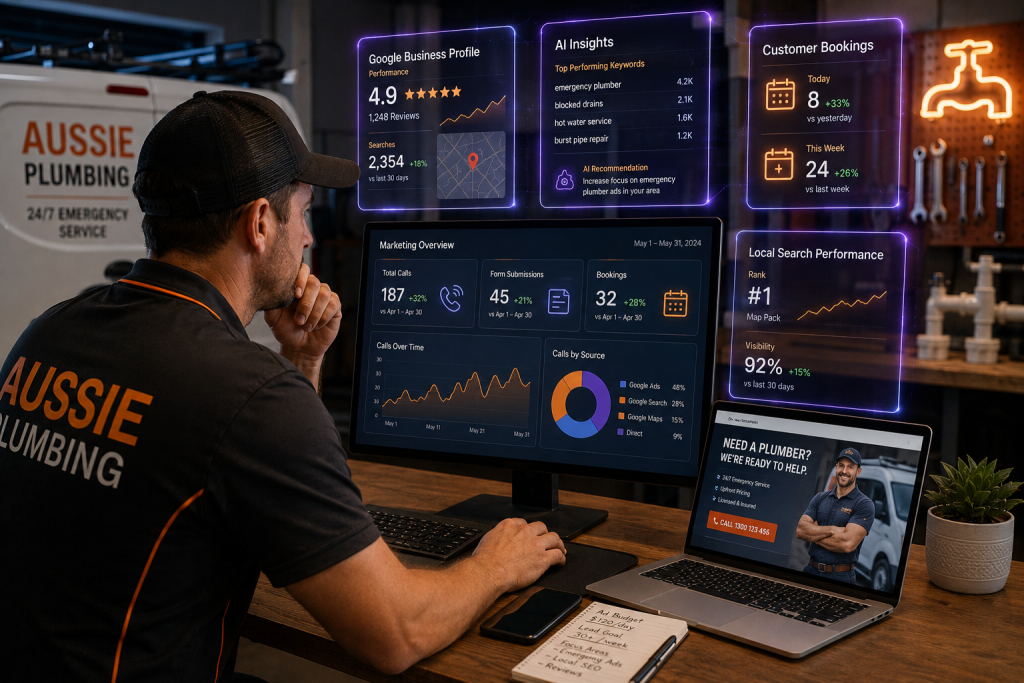
Australian plumber reviewing online bookings, Google Business Profile performance, and digital marketing analytics.

You just paid your apprentices. But looking at next week’s schedule, you see worrying gaps. Word-of-mouth used to keep your vans busy all year round. Lately? Those referrals are drying up. And it’s incredibly frustrating to watch a newer competitor get booked out for weeks while you wait for the phone to ring. To stop relying on referrals, Australian plumbers must capture customers actively searching for help right now. The best strategy combines an updated Google Business Profile for local map rankings, strict Google Ads for burst-pipe emergencies, and a fast mobile website built for phone calls.  If you don’t give clear answers to Google and new AI search tools, you’re handing those jobs straight to your competitors. I’m breaking down the truth about Google Business Profile for plumbers, the simple math behind Google Ads for plumbers, and why copying common plumbing marketing ideas is often a mistake that wastes your budget. Essential Takeaways Plumbers can get more customers by showing up when people need immediate help, using targeted Google Search ads and local Google Maps optimisation. Creating specific website pages for every suburb you service and making sure your business name, address, and phone number match perfectly everywhere. Improve your website speed. Make sure it loads in under two seconds and place a highly visible, clickable phone number right at the top of the mobile screen. Why Your Competitors Are Stealing Your Customers Online (And How to Fight Back) Here is a viewpoint that many marketing agencies miss: brand awareness is not the main priority for a homeowner in a crisis. When a hot water system breaks and floods a hallway at 6 AM, homeowners do not have time to read your company history. They only care about how fast you can arrive and whether they can trust you. They grab their phone and type “plumber near me.” Or, as we see happening more frequently, they use voice search. They ask AI tools on their phones, “Who is the best emergency plumber open right now in my area?” This is how search operates today. AI tools like ChatGPT and Google’s AI Overviews do not just read your website. They scan it for specific facts. If your website does not clearly state your 24/7 hours, your upfront pricing, and the exact suburbs you cover in plain text, the AI might skip past you.  It will feed that emergency plumbing call straight to the competitor down the road who provided clearer data. If you want to know how to market my plumbing business today, you have to communicate clearly with both stressed homeowners and smart AI search bots. Should a Plumber Even Have a Website in Current Times? Yes. But most plumbing websites act like passive digital brochures. You do not need a brochure. You need a reliable system that captures plumbing leads. Let’s look at the reality. A recent survey found that over 60% of websites had phone-number issues that could cause lost sales. A beautifully designed plumbing website without clear trust signals and a sticky phone number at the top is just draining your ad budget.  I’ve seen expensive custom websites fail to generate calls simply because the designer hid the phone number in a menu to make the page look “cleaner.” Top 5 Website Mistakes That Are Costing You Jobs Why do some plumbing websites get no leads? Often, they accidentally make it too hard for the customer to reach out. Here are the common roadblocks: No Click-to-Call Button Forcing a stressed homeowner to memorise your number and type it into their phone is a quick way to lose a booking. Make the number a simple, clickable button. Hiding the Call-Out Fees People worry about hidden costs. Be completely transparent. Say “$0 Call-Out Fee” or “$99 Dispatch Fee.” Giving them upfront information builds instant trust. Heavy Videos and Sliders I recommend removing massive video backgrounds on your homepage. They slow down your site significantly, and most visitors scroll right past them anyway. Zero Trust Anchors If you are fully licensed and insured, put that text at the very top. Show your real licence number. Prove you are a qualified, professional business right away. Unrealistic Stock Images Homeowners prefer real life over fake models holding perfectly clean tools. Use real, everyday photos of your actual vans and your team working on real pipes. The Mobile-First Rule: Why Slow Speeds Send Customers to Your Competitors Emergency searches usually happen on mobile phones. And they often happen on standard 4G or 5G connections. If a customer is standing in a flooded kitchen, they are not sitting down at a desktop computer. They are on their phone. If your fast-loading plumbing websites are actually slow, and it takes four seconds to load, that customer will likely hit the “back” button and call someone else.  Advertising for plumbers only works if the page loads instantly. Make your pictures smaller. Clean up your site. A fast website directly protects your revenue. Plumbing Website Layout to Turn Visitors Into Booked Jobs There is no need to guess what works. Use this proven layout to turn online visitors into actual plumbing bookings: The Sticky Header: Your phone number and a “24/7 Emergency Service” badge must stay locked at the top of the screen, even when the user scrolls down. The Hero Section: Use a real photo of your van parked in a local street. The main text should be welcoming and direct: Your Trusted Emergency Plumber in [City]. The Trust Bar: Just below the main image, display your 5-star Google review rating and your Master Plumbers badges. The Service Blocks: Create large, easy-to-tap squares for your main jobs. Use clear boxes for Blocked Drains, Hot Water, Gas Fitting, and Leak Detection. Dominating Local Search: How to Get Free Organic Plumbing Leads Paid ads are wonderful for quick visibility. But how can plumbers get leads without paid ads? The answer is steady, highly specific local search optimisation. This is exactly what SEO for plumbers in Australia

Best Dental Marketing Strategies in Australia to Get More Patient Bookings

Australian dentist reviewing online patient bookings and local dental marketing performance.

You are looking at your booking system for the week, and there are way too many empty slots. You recently paid a dentist marketing agency in Australia thousands of dollars, but the phone is quiet.  You are not the only one. I talk to practice owners every day who are angry. Their competitors are booked out for weeks. Meanwhile, they are struggling to get new patients in the chair. To attract more dental patients in Australia, clinics must stop running generic ads and focus on local search intent. The best dental marketing strategy combines an optimised Google Business Profile for “near me” searches, emergency dental Google Ads for fast patient capture, and a mobile website that allows instant online appointment booking.  If you do not show up on page one of Google Maps, or your website is hard to use, you are losing money every day. I’m breaking down the truth about Local SEO for dentists, the exact math behind Google Ads, how AI search engines are completely changing how patients find you, and why common advice about social media is actually a trap. Essential Points The best dental marketing strategy is reaching people exactly when they are in pain using local Google Maps optimisation and targeted search ads. Make your site load in under two seconds, show prices or payment plans, and add a simple online booking button to improve conversion rates. A steady stream of 5-star Google reviews pushes your clinic higher in local map rankings and builds fast trust with new patients. Why Your Dental Clinic Isn’t Getting Enough Patient Bookings (And How to Fix It) Here is something most marketing people will not tell you: getting more website traffic is usually not your main problem. I’ve seen dental marketing Australia campaigns fail completely because practice owners only care about getting clicks. But clicks do not pay your staff. If 500 people visit your website this month and nobody books an appointment, your ads are not the problem. Your website is the problem. The “Traffic vs. Conversion” Problem Conversion means turning a website visitor into a paying patient. Most dental patient acquisition strategies fail right here. People leave a dental website for three very simple reasons.  They cannot find the specific treatment they need.  They do not see if you accept their health fund.  It is just too hard to contact you after hours. How to Fix Your Patient Flow You fix this by treating your website like your best front desk receptionist. It needs to answer basic questions instantly. It needs to make booking an appointment completely effortless. If people have to search for your phone number, they will just go to the next dentist on Google. The Psychology of Patient Trust: How Australians Choose a Dentist Before you spend money on dental advertising in Australia, you need to understand how patients think. Fear of Pain and Cost People are scared of the dentist. They are terrified of physical pain, and they are equally terrified of a massive bill. When a person searches for a “dentist near me,” they want to feel safe. Empathy will always beat fancy medical terms. Your marketing must show that you are gentle, clear about pricing, and easy to talk to. The Power of Online Proof Let’s look at the numbers. A 2023 report found that Australians choose healthcare based on access, cost, and convenience, with 1 in 5 going online first for health advice. As one patient in a recent feedback group said: “I just want a dentist who will not judge how bad my teeth are and will not overcharge me.” You need to show online proof that you are exactly that kind of dentist. 7 Common Dental Website Mistakes That Cost You Patients Your website is the centre of your digital marketing for dentists. If it is broken, all the money you spend on ads is wasted. Here are the biggest mistakes I see: No online appointment booking: Forcing people to call during your exact business hours is a huge mistake. Many people want to book their appointment at 9 PM while watching TV. Use a tool that lets them do that. Using fake stock photos: Pictures of fake, perfect models holding apples do not build trust. Use real photos of your actual team, your waiting room, and your clinic front. Hiding your prices: You do not need to list the exact price for every filling. But you must give starting prices or show payment plan options. Bad mobile design: Most people search for a dentist on their phone. If your dental website UX is not thumb-friendly, they will leave immediately. Slow loading speeds: If your website takes more than three seconds to load, half of your visitors will close the page. Make it fast. Missing trust signals: You need to proudly display your ADA membership badges, your real Google reviews, and short bios about your doctors. Lumping all services together: Do not put general checkups, Invisalign, and dental implants all on one page. This hurts your local dental keywords. Make a separate page for each service. Proven Dental Lead Generation Strategies That Actually Work in Australia How do dentists attract more patients? They show up when patients are actively looking for help. Here is exactly how to do that. 1. Dental SEO Is SEO worth it for dentists in Australia? Yes, 100%. But you do not need to rank across the whole country. You only need to rank in your specific suburb and the ones right next to you. This is called Local SEO for dentists in Australia. The AI Search Shift (GEO & AEO) The game has changed recently. Patients are not just scrolling traditional Google links anymore. They are using Google’s AI Overviews, ChatGPT, and other AI platforms to ask direct questions. This is where Answer Engine Optimization (AEO) and Generative Engine Optimization (GEO) come in.  To rank on AI platforms, your website must give clear, direct answers without fluff. If a patient asks